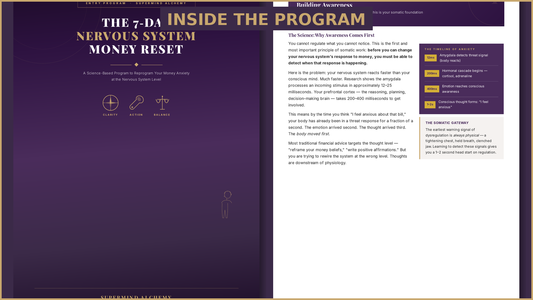
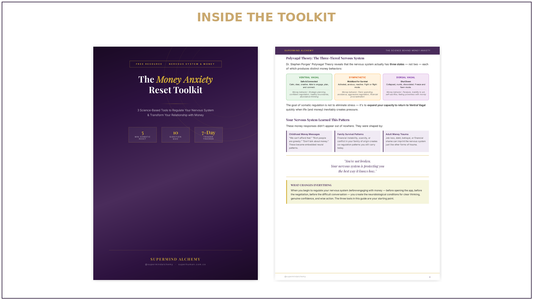
Free PDF guide • No credit card • Science-backed

Based on Polyvagal Theory & Somatic Experiencing
Used by therapists, coaches, and six-figure professionals
Not therapy • Not financial advice • Trauma-informed protocols

MY STORY

For a long time, I thought money anxiety was a mindset problem.

I thought if I could think more positively, plan harder, stay disciplined, repeat the right affirmations, or finally “fix” my relationship with money, I would stop spiraling every time money came up.

But my body had a different story.

I could understand money logically and still feel my chest tighten before checking an account. I could know what decision made sense and still freeze when it was time to act. I could earn more, learn more, plan more - and still feel like money was a threat.

That was the turning point for me.

I realized the problem was not that I needed more willpower. It was not that I was “bad with money.” It was not that I needed another manifestation ritual, budgeting hack, or mindset upgrade.

My nervous system had learned that money meant danger.

And when your body reads money as danger, your thinking brain is not fully in charge. You don’t just “choose better.” You fight, flee, freeze, fawn, over-control, avoid, overwork, undercharge, overspend, or shut down - not because you are broken, but because your body is trying to protect you.

Somatic Money was born from that realization.

Instead of trying to think our way out of a physiological response, this work starts where the response actually happens: in the body.

Somatic Money combines nervous system education, Polyvagal Theory, Somatic Experiencing principles, interoception, and trauma-informed body-based practices to help people recognize and regulate their money stress responses before making financial decisions.

This is not manifestation.
This is not financial advice.
This is not therapy.

It is education and practical regulation support for people whose bodies react to money before their minds can reason with it.

I created Somatic Money for high-achievers who look functional on the outside but still spiral, freeze, over-control, or collapse around money.

For the founder who raised capital but still checks accounts compulsively.
For the freelancer who cannot type the price into the proposal.
For the professional who knows they deserve more but shuts down in salary conversations.
For the parent who carries invisible financial fear while holding everything together.
For the person who has tried mindset work and quietly wondered, “Why is my body still terrified?”

You do not need to be fixed.
Your nervous system is not broken.
It is doing what it learned to do.

And with the right conditions, your body can learn something new:

Money is not danger.
A financial decision is not an emergency.
You can pause before you react.
You can regulate before you choose.
You can build capacity for money without abandoning your body.

That is the work of Somatic Money.

Not forcing confidence.
Not pretending fear is abundance.
Not bypassing reality.

Just one regulated money decision at a time.

Questions You're Probably Asking

Is this therapy?

No. Somatic Money provides educational tools for nervous system regulation around financial
stress.
This is not therapy, not medical treatment, and not a substitute for working with a li
censed therapist.
Many people use Somatic Money *alongside* therapy - they address different layers.
If you're in crisis (financial or mental health), please seek professional support.

Is this financial advice?

No. Somatic Money teaches body-based regulation - not investment strategies, tax planning,
or budgeting systems.
We don't tell you *what* to do with your money.
We teach you how to *be in your body* when you're making money decisions.
For financial planning, consult a certified financial planner.

How is this different from money mindset work?

Money mindset work focuses on thoughts, beliefs, and "reprogramming your subconscious.
Somatic Money focuses on your nervous system the body-based responses that happen before you think.
Example:
→ Mindset work: "Change your thoughts about money."
→ Somatic Money: "Notice when your body goes into Fight/Flight/Freeze around money and regulate before deciding."
Mindset is top-down (brain → body).
Somatic is bottom-up (body → brain).
Both can be useful. But if mindset work hasn't worked for you, it's because the body response wasn't addressed.

What if I don’t have “trauma”? Will this still help?

You don't need diagnosed trauma to benefit from nervous system regulation.
If you:
→ Feel anxious around money
→ Avoid financial tasks
→ Make impulsive money decisions under stress
→ Freeze during pricing or salary conversations your nervous system is responding to money as some level of threat.
You don't need to label it "trauma" to regulate it.

How long does it take to see results?

This isn't see results in 3 days.
Nervous system regulation is a practice not a quick fix.
What you might notice quickly (days to weeks):
→ You can check your bank account without spiraling
→ Pricing conversations feel less terrifying
→ You recognize when you're in Fight/Flight/Freeze before making a decision
What takes longer (weeks to months):
→ Building Ventral capacity (staying regulated longer)
→ Rewiring deep patterns (e.g., money = danger)
→ Changing habitual responses under stress
It depends on:
→ How dysregulated your nervous system is to start
→ How consistently you practice
→ Whether you're addressing other layers (therapy, financial planning, systemic issues)
Be patient with your body. It's learning.

I’m already in therapy. Should I do this too?

Many people use Somatic Money while in therapy.
Therapy helps you understand why you respond to money the way you do.
Somatic Money gives you in-the-moment tools to regulate when your body reacts.
They complement each other.
(And if you want to bring these tools into your therapy sessions many therapists
are familiar with Polyvagal Theory and Somatic Experiencing.)